
Wu, Kraft, DaRosa Lay Out Boston’s Artistic Future at Mass Creative Forum
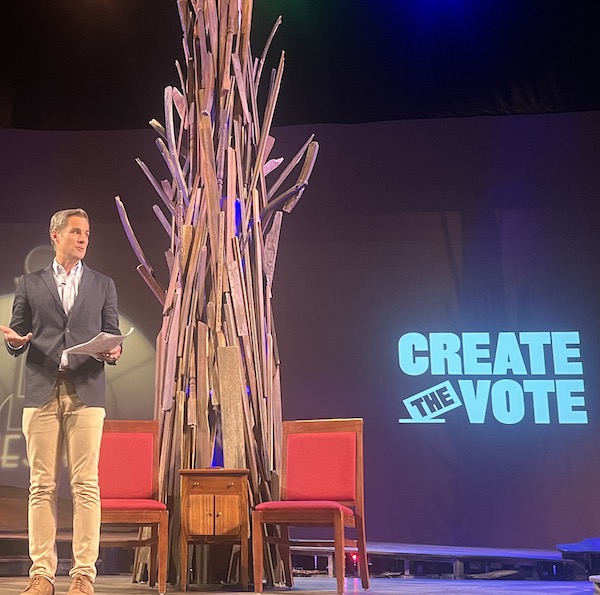
Mass Creative’s Create The Vote campaign held its Mayoral Forum on Arts & Culture on Wednesday. In separate, thirty-minute interviews, host Jared Bowen questioned incumbent Michelle Wu, philanthropist Josh Kraft, and community advocate Domingos DaRosa on how their administrations might engage with issues of the arts and those faced by artists.
The stereotype of the broke artist does not exist without reason, especially in an already expensive city like Boston. Fostering a robust cultural ecosystem requires consistent support from City Hall.

Wu said that ensuring the basic necessities do not become barriers is integral to ensuring that the arts are not a luxury. “It’s infrastructure, it’s workforce, it’s our economy, it’s community, it’s healing, it’s how to deliver every other issue that we’re working on. I’m proud that we have invested more in the arts than any other administration,” she said.
The Wu administration has pumped funds into the arts, allocating $26 million to organizations, individual artists, and the preservation of spaces like Humphrey Street and Charlestown Rehearsal studios.
Her office has been looking to recruit a new chief of arts and culture for the past eight months following the end of Kara Elliott-Ortega’s tenure in December.

DaRosa was critical of the length of Wu’s search. “How much planning do you need?” he asked to cheers from the crowd. He suggested that each of Boston’s communities should have its own chief of arts and defined a thriving cultural sector as “kids drawing on the sidewalk.”
“I want to see our young people brought into these spaces. Not only through our school system, but giving them an opportunity to understand within their own communities.”
DaRosa suggested funneling $2 million from the police budget into the school system and bringing art education and culture programs into public libraries, while also extending their hours.
“I don’t need six cops sitting on Mass and Cass,” he said. I need six teachers in our schools teaching art.”
Kraft’s plan to strengthen Boston’s art ecosystem was equally ambitious but less clear about where the funds would come. He suggested establishing a new program called All of Our Roots to celebrate diversity in Boston.

“We might have a Latino dance and music night, and the catering will be done with Vietnamese cuisine. Or we’ll do a fashion show that celebrates the unique diversity of our entire African diaspora in the city of Boston,” he said.
In contrast, Kraft recognized that Boston is predicted to lose $1.7 billion in commercial real estate over the next five years and will come into tough fiscal times. While he cannot name the precise figure, he pledged that the arts will receive an allocation commensurate with the programming needs of his own arts chief.
He added that Boston might rely on philanthropy as a potential avenue for greater funding. “I think there’s a lot of folks in the private sector that, like everyone here, believe in the power of the arts,” he said. “…Sometimes when you work with a funder, those folks have ideas on how to make something more of what we have and how to help you operationalize it.”
Funds across the board have been threatened as the Trump administration wields the power of the purse to enforce what Bowen called “the newly defined values of the United States.”
Wu said her administration would continue to stand against the White House. She cited multiple ongoing lawsuits meant to ensure Boston’s federal funding is not conditioned on ceasing support for, and recognition of, marginalized identities.
Kraft affirmed that he would speak loud and proud about the work of Boston’s artists, and when prompted by Bowen, that he was prepared for a potential standoff with the White House.
DaRosa was much more outwardly critical of President Donald Trump, stating: “This individual in the White House is destroying because he doesn’t have anything else to do. He has never successfully run a business. He has never successfully run a family. He does not know what it means to have empathy and compassion.”
He also suggested that “Everyone knows each state has its own constitution and our constitution supersedes the federal constitution.” This is not true, however. The US Constitution’s Supremacy Clause establishes the federal government as legally supreme over the states.
He added that his administration would maintain a line of communication with the White House, but noted that “[Trump] is only going to be there a few more months.”
Bowen corrected that Trump was only six months into his second term. “People are getting involved, so he might not be here for the next three and a half years,” DaRosa said.
All three candidates projected that funding for cultural programs would be a priority. Wu and Kraft shared common ground that keeping the city affordable is integral to the arts, though they differed on means, methods, and public versus private patronage. DaRosa, as usual, brought a certain dark horse populism that earned vocal reactions from the crowd.
A preliminary election will be held on September 9, coinciding with the upcoming city council race. The mayoral election will be held on November 4.


Maureen Dahill is the founder of Caught in Media. Once a longtime wardrobe and prop stylist for brands such as Rue La La, TJ Max & Hasbro, she is a devoted lover of vintage clothing, Martini Mondays, Castle Island, AND a 4th generation South Boston native. Mother of three, married to Peter G.
Councilor Flynn to Hold Hearing to Discuss Boston’s Rodent Action Plan (BRAP) Friday, October 23rd, at 10 AM
Nine Questions, One Ballot: What Voters Need to Know Before Election Day
USS Constitution to Celebrate 229th Birthday with Final Sail of the Season