
SBANP hosts mayoral forum on affordable housing, South Boston schools, and outdoor drug use in the neighborhood
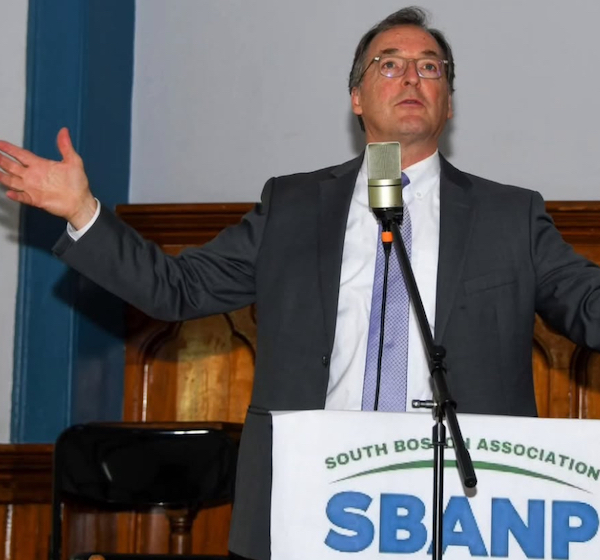
The South Boston Association of Nonprofits (SBANP) joins organizations across the neighborhood to enhance and expand the services they offer. Their members include the South Boston Neighborhood House (SBNH), the South Boston Neighborhood Development Corporation, and the Gavin Foundation, alongside a range of other integral community programs. On Tuesday, August 26, the association held a mayoral candidates forum at Fourth Presbyterian Church to discuss pressing issues with incumbent Mayor Michelle Wu and millionaire philanthropist Josh Kraft.
After a brief intro from Fourth’s Co-Pastor Burns Stanfield (complete with an amen), SBNH teacher Kathleen Cawley, and executive director Kathy Lafferty presented what the candidates would do to prevent drug use in Moakley Park.
Kraft proposed reinstating the Community Syringe Redemption Program (CSRP) with funding from private charitable sources. He has negotiated with two potential donors offering $1.2 million but chose not to reveal their identities.
He also proposed creating the Recover Boston Campus, as outlined by the Newmarket Business Improvement District in 2014. The project would establish a temporary recovery facility with mental health and detox services, workforce development training, and housing options to support patients during their recovery. The billionaire hopes that with support from the state and surrounding municipalities, this facility could open within six months of his election.
Wu celebrated her prohibition on tent encampments and the empowering of Boston police to respond to incidents as a city councilor, as well as the infrastructure her administration has put in place to combat encampments. The mayor is now focusing on ending outdoor drug use. “We have been putting in place new plans, adding bike patrols, adding more enforcement, adding ways where our public health and public safety are coordinating on voluntary treatment and involuntary treatment that is available,” she said.
Wu added that her administration has worked with the Gavin Foundation to ensure there are beds on standby for addicts who report themselves to police or public health officials.
“We have been tracking the numbers, and although it doesn’t feel like it, Boston has taken some important steps forward,” she said. “Overdoses are significantly down. The number of people who need housing is significantly down… All of that is moving in the right direction, but now it is concentrated more in smaller areas in our neighborhoods.”
James F. Condon School teacher and BPS parent Courtney Subatis followed, asking how their respective administrations might improve the Tynan, Perkins, and Up Academy schools, and how they might improve the school lottery system to ensure equitable access to high quality education.
Kraft said he would audit BPS school properties, demographics, and populations, and potentially downsize administrative staff at BPS headquarters “I know in the last 10 years, we’ve lost 8,500 students, but we’ve added 150 jobs, I believe, administrative jobs. I think it’s time to redirect some of that money back to the classroom,” he said.
He also suggested splitting the superintendent’s responsibilities into two separate positions. “One superintendent can focus on what they know best – academics,” he said. Another would serve as “superintendent of operations,” ensuring buses run on time and school safety. “And we think that can be a person without an education.”
Kraft also committed to reexamining the exam school admissions, emphasizing equity without shutting out students based purely on zip code. “We’ve got to balance the meritocracy, the zip code, and the equity to make sure everybody is getting a fair swing,” he said. Overhauling the totality of BPS high schools to improve the quality of education outside of the exam school system was also called a priority.
Wu celebrated stabilized enrollment, rising graduation and attendance rates, and reduced chronic absenteeism, but noted there is still work to be done.
She said that an audit has taken place over the past four years and that her administration has emphasized improving facilities. She highlighted the Building Experience Dashboard, a database rating the facilities and services offered by each BPS school, as an asset to be transparent about what work needs to be done.
“We have too few high-quality seats that meet our students’ needs compared to the population that we already have,” said Wu. “As long as we have certain schools that are underperforming, no matter what the lottery rules are, it’s going to be unfair.”
She also claimed nearly every high school has been matched with a local university or community college to offer early courses for every student, regardless of special education or language ability.
Finally, longtime neighbor and Patriot Homes resident Peg Thompson joined SBNDC executive director Donna Brown shared that despite the organization’s best efforts, there are still people who fall through the cracks. Developers paying into the Inclusionary Development Policy fund as an alternative to building affordable units on site have further made South Boston, especially the Seaport, unaffordable. Brown added that the developers of 776 Summer St, Redgate, and Hilco Redevelopment Partners had even reneged on their promise to keep roughly 100 affordable units on site.
The two asked if the candidates would commit to ensuring 776 Summer St’s units remain on site and how they might facilitate more affordable housing being built in South Boston.
“If a developer or builder made a commitment in order to get their permits pulled and approved, then they need to be held accountable to that commitment,” said Kraft.
He called the requirement that 20% of new units be affordable, fungible. Of the 26,000 units of housing that have received permits but cannot be built due to high cost, lowering the requirement to 13% would result in 3,380 affordables. “In the end, availability equals affordability,” said Kraft.
He added that he would sit down with Gillette and the residents most impacted by development to come to an agreement that works for both parties. He did not outline an example of what this agreement may look like.
Kraft also touted that Groma, an integrated real estate investment, development, and management company, and tech startup holding 600 units, had signed up for his plan for opt-in rent control.
Wu said that housing costs have spiraled out of control, despite her administration dedicating more funding to affordable housing than any other.
“There is no scenario where developers will be able to walk back how much affordability that they have committed to in the community, but in different places across the city where financing is close, we are having conversations about whether relocating some or all of the affordable units still in the neighborhood and nearby, but offsite, would make a real difference,” she said.
She called her administration’s work to create new programs to boost homeownership and fund redevelopment and maintenance of key public housing developments a key distinction between her and Kraft. She opposed his rollback of the 20% affordable requirement and said that the amount chosen was backed by data and research.
Both candidates committed to reconvening with SBANP within six months of their election.
Community organizer Domingos DaRosa and former police officer Robert Cappucci were not included in the forum, drawing criticism online “It’s a disappointment that both myself and Mr. Cappucci continue to get left out of events,” DaRosa posted to Instagram. “No matter if you support us or not, we should still be included as WE ARE ON THE BALLOT.”
The Preliminary Municipal Election will be held on September 9, with early voting running between August 30, and September 5. The mayoral election will take place on November 4, with early voting between October 25-31. More information on polling locations can be found here.
Image via South Boston Neighborhood Development Corporation on Instagram


Jacob Downey is a contributor to Caught in Dot. He is formerly of The Clock, Plymouth State University’s award-winning student newspaper. He enjoys spending time with his two kittens – Gin and Tonic – reading Uncanny X-Men and writing about local government meetings.
Good Neighbor Cafe block party brings free coffee to O Street with a side of controversy
Flynn Renews Call for Boston “Rat Czar” After Report of Rat Jumping Into Child’s Stroller in Southie
South Boston Obituary: Gretchen (Lindenfelzer) Crowley